


 Free Newsletter

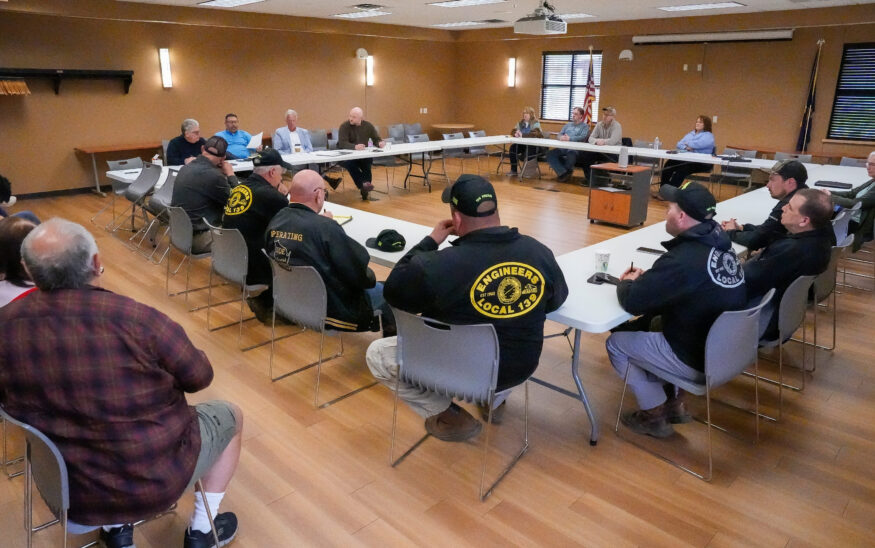
Residents gather for a public forum on Wednesday, May 13, 2026, at Wrightstown Village Hall in Wrightstown, Wis. The meeting is the first in a series of public forums to give residents multiple opportunities to gather information and provide feedback on a potential data center development in the community. (Tork Mason/USA TODAY NETWORK-Wisconsin)
Wrightstown tensions high amid data center proposal
By: USA Today Network//May 14, 2026//


By JESSE LIN
USA TODAY Network via Reuters Connect
Wrightstown village officials’ willingness to hear out future data center proposals met public disapproval on May 13 at the village’s public forum to gauge resident opinion.
At times, the three-hour meeting in the Village Hall that gathered about 20 people turned into open debate.
Meanwhile, emails show the village administrator and Cloverleaf Infrastructure representatives have been talking about a possible data center since at least January.
Members of the public cited concerns surfaced by data center opponents in Greenleaf in January and at the May 5 Wrightstown Village Board meeting: power consumption, water usage, the size and fit of a large facility on rural land, construction noise and light pollution.
Some residents said they were skeptical of the ultimate economic benefit and feared being left with a shell of a building once business was finished.
Several repeatedly asked the village to adopt a moratorium that would pause proposals for any data center, saying residents disapproved of officials giving any thought to a large-scale warehouse holding internet servers.
Village Administrator Travis Coenen and two Village Board members in attendance, Sue Byers and Ryan Roebke, rejected a moratorium. Roebke said there was no proposal to slow down.
The officials stuck by the village’s stance that future proposals would be considered on an individual basis. They emphasized the village’s yearly budgetary struggles to maintain and upgrade public services as part of their considerations.
“You’ve hired a group of people to work on your behalf,” Byers said. “You might not like the way we’re looking at this, but we’re responsible for looking into things before stuff hits the fan.”
Les and Karen Seagren of Wrightstown mostly sat quiet through the meeting. They said they’d moved from the Chicago metro area for Wrightstown’s quietness and opposed a data center.
Les Seagren said some of the opposition was “over the top” and that “it serves no purpose on either side to be confrontational in business,” a consequence he attributed to fear.
Karen Seagren said she left with the impression that some officials were “trying to be as open and transparent as possible” but that others were “trying to steer people.”
Public involvement ‘earlier than we normally would’
In a social media bulletin, the village billed the meeting − the first of four so far scheduled − as informal and conversational times for officials “to better understand community perspectives and concerns should a proposal be received in the future.”
Presiding over the meeting were attorneys Logan Glasenapp and Christopher Smith from the Milwaukee-based law firm von Briesen & Roper, as well as Claude Lois, a consultant project manager with engineering firm Kapur and Associates.
The law firm has counseled municipalities through several of the state’s other data center developments. Smith is also the village attorney for the Village of Mount Pleasant, home to a recently operational Microsoft data center.
Smith said the village hired the law firm following rumors shared at a Village Board meeting speculating that land near Wrightstown High School was being considered for a data center. He said the village wanted to “start earlier than we normally would” on public involvement and that the feedback given from the public would inform village officials on the kinds of restrictions and asks that would be demanded of a developer.
Smith defended the village’s position of needing to consider growing its tax base, saying that the state’s “extremely restrictive” limits on how communities can raise taxes to fund public services were leaving some places “just absolutely drowning.” New development “is their only lifeline,” Smith said.
Contact with data center developer was ‘minimal,’ Wrightstown says. Emails show talks since at least January
Village officials and Smith repeatedly said during the meeting that no proposal had been discussed between the village and Cloverleaf Infrastructure, a data center developer that’s been looking for months to build a large-scale data center in northeastern Wisconsin. The company had told officials in the Kewaunee County Town of Carlton their wishes for about 800 acres of land for a 100-megawatt facility.
“The contact they’ve had in the village is minimal,” Smith said, adding, “We have no idea if this thing is actually going to go anywhere or if they’re serious.”
Coenen said the extent of the village’s interactions with Cloverleaf Infrastructure had been the company asking about the village’s zoning laws. Coenen also said that in the wake of data center discussions in Greenleaf, he had talked with the communities of Beaver Dam and Port Washington with experience of large data center developments for the purposes of “trying to educate myself.”
Roebke said he had “exactly zero conversations” with Cloverleaf Infrastructure.
The day before the meeting, Cloverleaf Development’s chief development officer, Aaron Bilyeu, told the Green Bay Press-Gazette that the company was not involved in the village’s public input sessions. He did not respond to a clarifying question if the meetings were triggered by any talks between the village and the company.
Emails obtained by the Green Bay Press-Gazette show village officials engaged with representatives from Cloverleaf Infrastructure since at least January.
In a Jan. 9 email, Coenen asked Bilyeu and Travis Armistead, a project development manager for Cloverleaf, on the general location of an anticipated facility. He wrote that this could “allow me to develop my presentation strategy and contribute any insight that may be helpful.”
Armistead responded on Jan. 12 that an exact location had yet to be determined, but the company had “a few leads which hopefully land us fairly close to the Village of Wrightstown’s border.” That was the same day that Armistead called the Village of Greenleaf president to say that the company would no longer pursue data center plans there.
Armistead continued that he wanted to confirm a future date for Cloverleaf Infrastructure representatives to go to the village in person “to discuss the potential development with you and your fellow council members.” He signed off the email saying that he was “Looking forward to getting back into town!”
Coenen responded on Jan. 14, asking if Armistead, Bilyeu, and a third Cloverleaf Infrastructure representative could join a virtual meeting “for a closed session” around 7:30 p.m. Jan. 20, the same day of a scheduled Village Board meeting. Board meeting minutes show Village Board members went into closed session as the final agenda item before adjournment.
In response to Armistead sending a 2024 paper on local data center development on Jan. 23, Coenen wrote that he had already seen the paper and sent it to the Village Board “while the Greenleaf controversy was going on. We will strategize on a better plan for Wrightstown as I see both Greenleaf and Kewanee [sic] have not gone well.”
Armistead on March 4 sent Coenen a two-page document that summarized the impact of data centers investments on local communities, including information on assessed value of data centers and community benefit agreements.
On March 11, Cloverleaf Infrastructure representative Parin Patel, a principal development manager, sent Coenen documents that Cloverleaf Infrastructure used to begin its data center project in Port Washington. Included were copies of a pre-development agreement and an amended pre-development agreement.
“We don’t need to follow the exact same approach here,” Patel wrote, “but they may be helpful reference points and can certainly be modified.”
Patel added, “We aim to be transparent, cover evaluation costs so the process isn’t a burden on the community and remain open to ideas on different mechanisms to help move the project forward.”
Three days later, on March 17, Coenen requested that Patel send “the zoning you used in other communities so I can get it in our zoning code rewrite.”
Wrightstown data center discussions
Three more discussions are scheduled at Village Hall, 325 High St.:
- 10 a.m.-2 p.m. May 19
- 4-7 p.m. May 26
- 2-6 p.m. May 31
Related Articles

Related Content





Today’s News
- Wisconsin lawmaker accepts award for helping pass DACA bill
- Plans for $107M Wauwatosa library gain momentum
- Trump signs additional tariffs on Canadian steel, aluminum and lumber
- Wisconsin Pre-Bid Meetings – Week of July 27, 2026
- Feds commit $5B to AI-powered research for construction
- Worker files NLRB complaint against Wisconsin painters union
- Lawsuit challenges Wisconsin Supplier Diversity Program
- Sheboygan TID proposal targets public incentives of $5M or more
- TOP BIDDERS: The biggest recent winning bids from around Wisconsin | July 21
- State warns of workers’ compensation scam targeting victims
- Washington County housing initiative brings back young homeowners
- South Milwaukee apartment project canceled after financing shortfall







Project Profiles
- First prefabricated bridge in US installed in Eau Claire County
- Illinois developer worked with Wisconsin contractor to build 258-unit Wauwatosa apartment complex
- VJS Construction raises the roof for Bruce Guadalupe Community School expansion project
- Microgrid pilot project will store energy for village affected by outages
- Dane County sees uptick in highway work zone crashes, on track to exceed last year
- The Hop streetcar will debut newest service route in fall with limited service
- FPC Live slims venue proposal to 1 downtown building
- Children’s Hospital urgent care center in Milwaukee gets first round of city approval
- With Sonag Construction shut down, feds move to block indicted owner from collecting leftover assets
- Four contractors selected to build border wall prototypes
- UW-Milwaukee’s Greenstreet shaping minds (and the city)
- Turning the Corner(s) (PHOTO SLIDESHOW)