


 Free Newsletter


A commission for the Milwaukee-Area-Racine-Kenosha commuter rail line will meet for the first time, a step toward a planned passenger train line stretching from Milwaukee to Chicago. (Photo courtesy of MARK Rail)
Wisconsin cities advance passenger rail plan to Chicago
By: Ethan Duran//December 3, 2025//


 Listen to this article
Efforts to establish a new passenger rail line between three southeast Wisconsin cities and Chicago will take another step in December.
The Milwaukee-Area-Racine-Kenosha Passenger Rail Commission will hold its inaugural meeting at 10 a.m. on Friday, Dec. 5, in Room 27 at Racine City Hall, city of Racine officials said in a news release.
The meeting will focus on establishing the commission’s organizational structure, officials said. It will also mark the start of coordination between Kenosha, Racine and Milwaukee to explore the feasibility of a passenger rail service between the three cities and Chicago and northern Illinois, officials added.
MARK is a resurgence of the effort to establish a rail line between the cities since the late 1990s. Originally named the Kenosha-Racine-Milwaukee commuter rail project, the plans were scrapped in 2011 when control of the Wisconsin Legislature flipped. The effort is now rebranded MARK to distance itself from the previous proposal.
In 2022, the city of Racine Common Council secured $5 million in federal funding for a feasibility study. The body also hired a consulting team, including DB E.C.O. North America Inc., Kimley-Horn, De Vor Communications and The Lakota Group to guide the process, a study presentation showed. AECOM will analyze existing real estate and future development along the line.
Creating the passenger rail commission will allow the group to apply for funding from the Federal Railroad Administration, the spokesperson said. The study will help the group reach its goal of entering a federal funding program.
The first possible funding avenue is the Corridor Identification and Development Program administered by the Federal Railroad Administration, the study presentation showed. The program, created by the 2025 Infrastructure Investment and Jobs Act, included $365 million for planning and development in 2022 with 5% of federal and state partnership program funding.
A total of 69 passenger rail corridors were accepted into the program, including four Wisconsin projects. The next funding opportunity is expected in late 2025.
The second potential option is the Capital Investment Grant administered by the Federal Transit Administration, the presentation showed. CIG supports fixed-guideway investments, including new and expanded commuter rail projects. The maximum annual appropriation for CIG is $4.6 billion.
The FTA requested $3.97 billion for fiscal year 2025 and $3.21 billion for New Starts. New Starts is a type of CIG project that creates a new fixed guide-way system or an extension that costs $300 million or more and receives $100 million or more in CIG funding, according to a program summary.
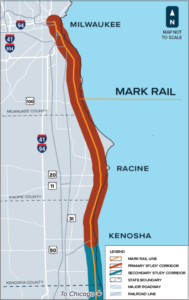
The primary study corridor is a Union Pacific Railroad between Milwaukee and Kenosha, with a secondary corridor extending to Chicago, the presentation showed. Currently, there is no passenger service north of Kenosha, but Metra connects Kenosha and Chicago. The proposed rail line is closer in proximity to Lake Michigan than Amtrak’s Hiawatha Train.
In 2022, the city of Racine received a $5 million grant from Congress as part of the Consolidated Appropriations Act. In 2021, the city passed a measure for federal investment.
The Wisconsin Department of Transportation and the Southeastern Wisconsin Regional Planning Commission determined a new passenger line would provide access to more than 400,000 jobs within 30 minutes by transit. Around half of homes in the corridor have incomes less than $50,000, according to planners.
The proportion of homes without access to a car in the cities of Kenosha, Milwaukee and Racine is twice the national average, the presentation showed.
“Regional connectivity is critical for promoting economic growth, attracting and retaining a skilled workforce, promoting tourism and creating a vibrant business community,” planners said in the presentation.
Racine officials said the commission’s early activities won’t use local funding, and the FRA Corridor ID program doesn’t require a local financial match to enter.
The corridor was identified as part of a larger commuter rail network in SWRPC’s VISION 2050 plan, which was updated in June 2024.
Friday’s meeting involves presenting the MARK Commission’s mission, approving bylaws and electing officers such as chair, vice chair and secretary.
Members include Racine Mayor Cory Mason; Dave Misky, assistant executive director of the Redevelopment Authority of the City of Milwaukee; Eric Haugaard, who represents Kenosha’s 1st District; Kevin Muhs, city engineer of Milwaukee; Maurice Horton, who represents the Racine’s 7th District; Alderman Robert Bauman, who represents the Milwaukee’s 4th District; Peter Barca; Scott Leonard; and Joan Wilk.
Related Articles

Related Content




Polls
 Loading ...
Today’s News
- TOP BIDDERS: The biggest recent winning bids from around Wisconsin | June 1
- WisDOT studying redesign of Walker’s Point interchange
- $2M outdoor improvements to begin at Appleton middle school
- Kenosha firm completes largest private affordable housing project in Wisconsin
- After federal DEI rollback, Wisconsin DBE recertifications plummet
- Milwaukee Tool plans 141,000-square-foot expansion in Menomonee Falls
- Wisconsin Pre-Bid Meetings – Week of June 1, 2026
- Milwaukee County investment helped bring Whitefish Bay development to life
- Milwaukee considers 12-story, 200-unit Harbor District apartment plans
- Wauwatosa students take next steps to ‘irreplaceable’ construction jobs
- Racine starts $130 million lead service line replacement project
- Federal court shelves lawsuit seeking to dismantle DBE program





Project Profiles
- First prefabricated bridge in US installed in Eau Claire County
- Illinois developer worked with Wisconsin contractor to build 258-unit Wauwatosa apartment complex
- VJS Construction raises the roof for Bruce Guadalupe Community School expansion project
- Microgrid pilot project will store energy for village affected by outages
- Dane County sees uptick in highway work zone crashes, on track to exceed last year
- The Hop streetcar will debut newest service route in fall with limited service
- FPC Live slims venue proposal to 1 downtown building
- Children’s Hospital urgent care center in Milwaukee gets first round of city approval
- With Sonag Construction shut down, feds move to block indicted owner from collecting leftover assets
- Four contractors selected to build border wall prototypes
- UW-Milwaukee’s Greenstreet shaping minds (and the city)
- Turning the Corner(s) (PHOTO SLIDESHOW)