


 Free Newsletter

Wisconsin data center boom will demand massive water, energy resources

Piping that is part of the close loop chiller plant at the Microsoft data center in Mount Pleasant, Wisconsin on Sept. 18, 2025. Microsoft announced plans to spend $4 billion to build a second data center in Mount Pleasant that it says will be the most advanced AI center in the world. (USA Today Network)
Wisconsin data center boom will demand massive water, energy resources
By: USA Today Network//April 9, 2026//


THE BLUEPRINT:
- Vantage Data Centers is building a hyperscale campus in Port Washington.
- The Microsoft data center in Mount Pleasant uses 8.44 million gallons annually.
- Vantage data center peak water use equals 65 typical homes.
- Wisconsin power production accounts for 74% of state water use.
PORT WASHINGTON – String lights hung on rafters above tables set with blue napkins, white flowers and numbered table cards inside the Memories Ballroom, a Port Washington mainstay for nearly a century.
But on this March afternoon, the building was filled with tension rather than celebration. Residents from Port Washington, Fredonia and neighboring towns came to voice concerns about a hyperscale data center being constructed across the street, as well as a proposed transmission line that could cut through forests, wetlands and farmland.
“We are landowners fighting this Goliath, but we are not backing down,” said Rev. Patti Plough, a pastor and co-founder of the Protect Fredonia Coalition, which opposes the proposed power lines under consideration.
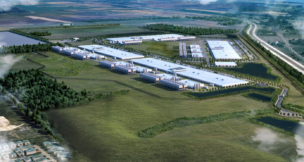
A four-building Vantage Data Centers campus will eventually rise, to be used by Oracle and OpenAI − an outcome many residents still have not accepted.
Data centers are experiencing unprecedented global growth, due to the explosive development of artificial intelligence and cloud computing. They are used to house IT infrastructure – the servers, storage systems and hardware on which our digital culture stands.
In the United States, Wisconsin is becoming an epicenter for data center development because of its abundant freshwater, cooler temperatures and relatively low land costs. Powering and cooling the vast amount of data center equipment requires enormous amounts of water.
The result ties water to energy at a level that most communities contemplating hosting a data center can’t fully grasp. The demand for water can extend to rivers, lakes and even other communities’ watersheds.
The Great Lakes region hosts about 20% of U.S. data centers, according to a University of Virginia analysis. Only Virginia and Texas rival the region in total facilities. Within the Great Lakes, Ohio and Illinois are the most mature markets, accounting for roughly 60% of the region’s centers, followed, in order, by Indiana, Minnesota, Pennsylvania, New York, Wisconsin and Michigan.
Wisconsin has lagged behind neighboring states, and now has roughly 40 to 50 data centers – depending on how they are counted – most of which are small facilities embedded in office or industrial buildings.
However, in the last two years the data center market has transformed into something Wisconsin has never seen before: massive, hyperscale projects, including Microsoft in Mount Pleasant, Vantage in Port Washington and Meta in Beaver Dam.
That shift has created an entirely new market, said João Ferreira, director of the Center for Economic and Policy Studies at the University of Virginia. As a result, much of the information researchers have on data centers, particularly their water use, hasn’t caught up to the plans already underway, such as in Port Washington. The research on hand offers only a snapshot of what’s to come, Ferreira said.
Because of this, Wisconsin could see its entire trajectory – economic and environmental – shift rapidly and unpredictably, without any clear understanding of the consequences.
Closed-loop systems cool servers, keep equipment running
To understand one use of water in a data center, think of a car radiator.
Increasingly, hyperscale data centers use closed-loop cooling systems, in which water circulates through pipes and absorbs heat from servers. The warmed water is carried away to be cooled, often using heat exchangers, chillers or cooling towers. Then it flows back through the system again.
In general, closed-loop systems withdraw less water and create less wastewater than other cooling methods because the water is continually reused.
Water in closed-loop systems needs to be flushed periodically because it cycles thousands of times a day, which can break down cooling chemicals and degrade water quality, said Andrew Chien, director of the Center for Unstoppable Computing at the University of Chicago. Data centers also will need to add water to make up for evaporation and small leaks, Chien explained.
Notably, the Center for Water Policy at the University of Wisconsin–Milwaukee found that not a single data center appears as an individual user needing a permit in the Great Lakes water use database.
The reason is that proposed data centers in the Great Lakes region tap into local water utilities, which makes them customers and not permit holders, said Melissa Scanlan, director of the Center for Water Policy. Because of that, there is no legal process to notify the public about a user with a potentially very large water demand.
That raises transparency concerns, Scanlan said.
Some companies have tried to soothe concerns.
Microsoft confirmed to the Milwaukee Journal Sentinel that it expects the data center in Mount Pleasant to use 8.44 million gallons of water each year once it is fully built out, the equivalent of about 13 Olympic-sized swimming pools. About 6 million gallons will be returned to the municipal water system, Microsoft said. It will replace the water in it’s closed-loop system about every six years.
The expected peak water use at Vantage’s data center in Port Washington is about 22,000 gallons per day, or the equivalent of what 65 typical homes might use, said Emily Backus, sustainability director for Denver-based Vantage Data Centers. Unlike Microsoft’s system, Backus said Vantage’s closed-loop system, which will use a mix of water, glycol and corrosion inhibitors, will not need be flushed.
Nevertheless, with no special permits required, information on water use is not spelled out publicly, and companies are not held accountable.
Further, it’s just part of the picture.
Electricity, the much bigger water footprint
Understanding a data center’s full impact means looking beyond just the water used on-site.
While closed-loop systems sound better, Scanlan said, they use more electricity to operate. If that power is coming from fossil fuel or nuclear power, it can have a much larger water footprint.
Research from Lawrence Berkeley National Laboratory shows that about 90% to 93% of a data center’s water footprint comes from electricity generation alone.
Ferreira calls this connection the water-energy nexus: the more energy a data center uses, the more cooling – and water – it typically needs.
In Wisconsin, power production is the state’s largest water user, accounting for 74% of total water use over a 10-year period from 2011 to 2021.
Wisconsin is part of the Midcontinent Independent System Operator, or MISO, grid where roughly 70% of electricity comes from fossil fuels, 14% from nuclear power and the remainder from wind and solar.
How much water is used depends on the energy source. For instance, coal plants withdraw about 19,000 gallons per megawatt hour, while natural gas uses roughly 2,800 gallons per megawatt hour. Nuclear plants also require large amounts of water. Wind and solar energies use negligible amounts of water.
Further the water impact may occur hundreds of miles away, in another watershed or even another state, rather than at the data center itself, Ferreira said. For example, much of the electricity powering Virginia’s data centers – the largest hub in the world – is imported from Maryland or Pennsylvania.
An analysis by Clean Wisconsin estimated that the Vantage data center in Port Washington, which will have power needs up to 3.5 gigawatts, would require at least 54 million gallons of water. That’s more than double the amount used every day in the city of Green Bay, according to the analysis.
While researchers can estimate this indirect water use, Ferreira said, the numbers rely on broad averages and can vary widely depending on the power mix and other factors. That uncertainty, he said, is why more transparency and better data are needed.
Importing electricity can have other impacts as well.
A new transmission line is needed to power Vantage Data Centers‘ project in Port Washington, and one of the two proposed routes would cut an entirely new path. Residents say it would disrupt forests, wetlands and key bird habitats, and run alongside many of Plough’s neighbors’ properties.
That same route also would cross a 400-acre forested wetland at the headwaters of Cedar Creek, which flows into the Milwaukee River, one of the few cold-water streams in the area. Critics worry it could increase runoff and harm water quality downstream, which could ultimately impact the city of Milwaukee and Lake Michigan.
Data center business models clash with climate change goals
U.S. data centers already account for more than 4% of electricity use, and are projected to rise to 12% by 2028.
In the Great Lakes region, data centers could account for more than 20% of electricity demand by 2040, with energy needs in Wisconsin, Indiana, Michigan, and Minnesota projected to more than triple by 2030.
While many big tech companies have climate and sustainability goals, they are all racing to get their data centers online faster than their competitors, said Clean Wisconsin’s Water Policy Manager Hannah Richerson.
Data center business models – which are pushing AI-data center growth faster than the U.S. can build clean energy to power them – clash with efforts to address climate change, said Scanlan, with the Center for Water Policy at the UW–Milwaukee.
The rapid data center boom is slowing the grid’s shift to clean energy, Chien said, explaining that when a center needs power immediately, that demand is often met by firing up fossil fuel plants.
According to a 2026 report by the Union of Concerned Scientists, replacing fossil fuels with wind, solar and battery storage could sharply reduce emissions and health costs, avoiding $8.7 billion in health costs in Wisconsin by 2050.
Microsoft told the Journal Sentinel that it’s “confident in our ability to meet our clean energy goals while supporting the growth of our datacenters.”
Backus told the Journal Sentinel it is working with We Energies to bring more wind and solar, which use minimal water, online.
Would Microsoft, Vantage agree to post water use?
The Journal Sentinel asked both Microsoft and Vantage officials whether they would consider a public dashboard that publishes real-time water use, and by what source, like coal, natural gas or wind and solar.
As a part of its goal of increasing transparency, Microsoft said it “will begin publishing water-use data for each data center region in the country, as well as our progress on replenishment.” Microsoft said the timing and format of that information is being worked out.
Backus, sustainability director at Vantage, told the Journal Sentinel it is committed to being water positive in Wisconsin, meaning it will protect more freshwater than it consumes each year. More details about how it will meet that goal are forthcoming, Backus said.
Vantage made no commitment to a public report. Backus said Vantage reports progress in a global sustainability report, “but we can also include specific site metrics where it might be necessary.”
Tech changes could leave communities behind
For local water utilities, the rapid growth of data centers presents a planning challenge. Water systems are typically built on 30-year timelines, said Nancy Love, environmental engineer at the University of Michigan.
The tech industry, however, moves much faster.
A utility might build out pipes and treatment capacity to serve a large facility, but if it closes or uses less water, the town is stuck paying to run and repair a system that’s bigger and more expensive than it needs to be, Love said.
This isn’t just hypothetical. In Michigan, cities like Flint and Benton Harbor installed water systems sized for more people and heavier industry than they have today. When those customers disappeared, residents were left with high bills, mounting debt and constant struggles to keep the aging system working safely.
Love said smaller towns with limited budgets are particularly vulnerable.
Environmental groups also have raised concerns about chemicals used in cooling systems, including PFAS, or forever chemicals. PFAS are linked to health risks, such as certain cancers, as well as reproductive, liver and thyroid problems.
Data centers must report chemicals that could interfere with treatment, but many consider cooling fluids proprietary. Smaller facilities may not have to disclose them, and municipalities aren’t required to make that information public.
To date, conventional wastewater treatment plants are not designed to remove PFAS, which would allow the forever chemicals to reach rivers, lakes and drinking water supplies.
A spokesperson for Microsoft would not confirm whether or not PFAS will be used in its cooling chemicals, stating the chemicals are proprietary and similar to antifreeze. The spokesperson said that “if any coolant with additives must be removed, it is collected and disposed of off-site per local regulation.”
Vantage confirmed it will not use PFAS in its closed-loop system.
Beyond municipal systems, experts say large industrial withdrawals of water also could affect groundwater and agriculture. Helena Volzer, senior source water policy manager at the Alliance for the Great Lakes, said major water withdrawals can compete with farm irrigation, lower aquifer levels and strain groundwater systems.
In several Great Lakes states, competition already exists among municipalities, agriculture, industry and private well owners for groundwater. Adding a massive new user like a data center can heighten tensions, especially during droughts or heat waves.
Volzer said water demand studies can help identify infrastructure gaps and potential water shortfalls, which can be especially helpful in areas like southeastern Wisconsin and northern Illinois, which face dwindling groundwater supplies and don’t have access to Great Lakes water.
Is everything just happening too fast?
Private wells running dry in a small Indiana town highlight how water scarcity still can emerge in the Great Lakes region.
In New Carlisle, some residents’ private wells ran dry near Amazon data centers and a General Motors EV battery plant beginning in 2024. The Indiana Department of Natural Resources ultimately attributed the issue to drought, which Volzer with the Alliance for the Great Lakes said highlights the growing groundwater demand and how quickly stress on local supplies can become a problem when large new water users arrive without clear safeguards.
Across Wisconsin and the broader Great Lakes region, experts are calling for stronger regulations and a more holistic framework to evaluate data centers before approving them.
Plough, of the Protect Fredonia Coalition, said right now it feels like a gold rush, with company leaders vying to see who can get data centers up the fastest, no matter the cost to everyone else.
Related Articles

Related Content






Polls
 Loading ...
Today’s News
- Milwaukee elementary school deemed total loss after inferno
- Leadership roles change at Bliffert Lumber
- TOP BIDDERS: The biggest recent winning bids from around Wisconsin | June 30
- Foreclosure judgement ordered for Neutral Milwaukee site
- HEAT IS ON: Construction experts share tips on working in record-breaking temps
- Judge halts tree clearing at Potawatomi State Park
- Groundbreaking set for $16M NeuVue mixed-use development in Milwaukee
- Architecture billings score low, but Wisconsin firms remain busy
- Wisconsin Pre-Bid Meetings – Week of June 29, 2026
- Meta, ABC partner on construction career academy amid data center boom
- The Gund Co. plans 110,000-square-foot expansion in Waukesha
- Milwaukee airport Amtrak project cost doubled since groundbreaking







Project Profiles
- First prefabricated bridge in US installed in Eau Claire County
- Illinois developer worked with Wisconsin contractor to build 258-unit Wauwatosa apartment complex
- VJS Construction raises the roof for Bruce Guadalupe Community School expansion project
- Microgrid pilot project will store energy for village affected by outages
- Dane County sees uptick in highway work zone crashes, on track to exceed last year
- The Hop streetcar will debut newest service route in fall with limited service
- FPC Live slims venue proposal to 1 downtown building
- Children’s Hospital urgent care center in Milwaukee gets first round of city approval
- With Sonag Construction shut down, feds move to block indicted owner from collecting leftover assets
- Four contractors selected to build border wall prototypes
- UW-Milwaukee’s Greenstreet shaping minds (and the city)
- Turning the Corner(s) (PHOTO SLIDESHOW)