


 Free Newsletter

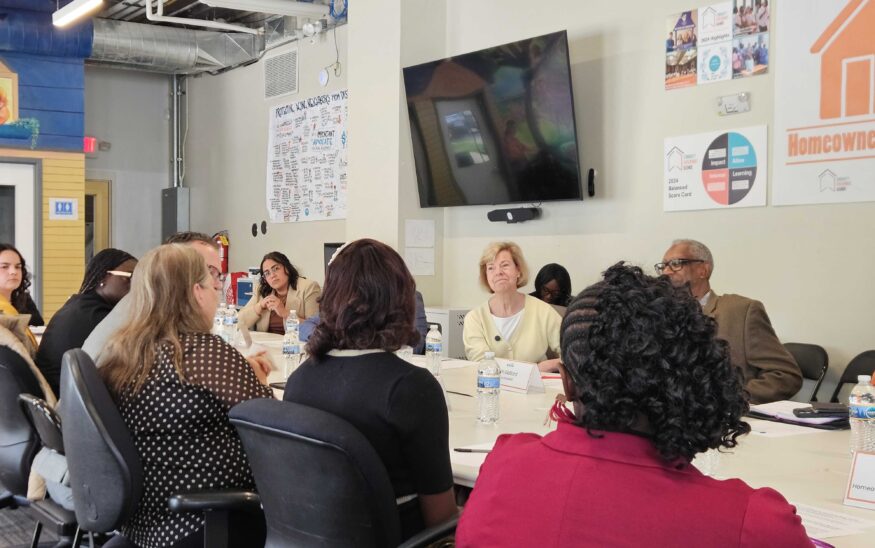
Sen. Tammy Baldwin, center right, talks to housing experts in a roundtable discussion in Milwaukee on May 1. (Ethan Duran)
Milwaukee homebuilders seek subsidies to boost affordable housing supply
By: Ethan Duran//May 7, 2026//


 Listen to this article
As pursuing homeownership becomes increasingly difficult for residents in the U.S., local homebuilders and federal officials discussed ways to free up more affordable housing supply. At a May 1 meeting in Milwaukee with U.S. Sen. Tammy Baldwin, homebuilders called for subsidies to offset the high costs of materials and labor.
Baldwin held a roundtable discussion with homebuilders, advocates and community development organizations at the Community Development Alliance Homeownership Lab in the Washington Park neighborhood.
The senator touted the 21st Century ROAD to Housing Act, a federal bill that would expand available financing for affordable housing and provide grants for planning and community development activities. The Senate recently passed the bill.
Housing in at a glance, in Milwaukee and beyond
In 2025, the median age of first-time U.S. home buyers was 40 and the median down payment for a single-family home was 10%, according to the National Association of Realtors. The share of first-time home buyers dropped to 21%.
In Milwaukee, a steep increase in assessed value made homeownership inaccessible for those making less than $50,300, a city housing report showed.
Across the U.S., the share of class A multifamily units in the U.S. increased by 18 percentage points over the last 25 years, making them more than half of the housing units built, according to commercial real estate data from Moody’s. Meanwhile, class B and C multifamily units fell by 18 percentage points.
Overall, developers are urged to build homes and buildings that generate higher rents, according to Moody’s. Builders have noted the cost of construction and labor make it difficult to produce homes currently, especially homes for low- and medium-income renters, without incentives.
City juggles different issues in the rental market
In a roundtable of around 15 people representing different parts of community development, advocates brought up issues with out-of-state landlords buying up houses.
They also noted the saturation of low-income housing tax credit housing in parts of the city such as Metcalfe Park, leaving barriers to renters who want to move into permanent housing.
Subsidies the ‘magic spice’ for producing low-income housing
Michael Melendes, representing Milwaukee-based Emem Group, said that community development officials were pushing “every lever and every button” to pencil out home production, but the greatest advantage for homebuilders was subsidy.
With help from the now-depleted American Rescue Plan Act and partners such as the Wisconsin Housing and Economic Development Authority, “That gave us a product that was workable, and we could expand the box,” to expand housing inventory, he added.
Another official noted that requirements like Build America, Buy America Act, which required iron, steel and other manufactured products used in construction to be made in the U.S., made it difficult for projects to be feasible.
Baldwin acknowledged the issue, and noted the law was meant to signal more domestic production and that federal agencies could provide waivers in certain cases.
Melody McCurtis, deputy director of Metcalfe Park Community Bridges, noted there were no subsidies for home rehabilitation.
At a roundtable discussion with Milwaukee County Executive David Crowley in late April, housing experts said the state lacked an affordable housing tax credit system and the disconnection between the state and local communities was a barrier to homeownership.
Teig Whaley-Smith, representing the Community Development Alliance, followed up on that meeting’s message.
“We need a statewide housing plan that meets the need of more than 60,000 new single-family homes we need. This isn’t just a Milwaukee problem. With the average age of homeownership now being 40 years old, that impacts every corner of the state. We really need the state to step in, because cities and counties can’t do this by themselves,” he added.
Related Articles

Related Content





Polls
 Loading ...
Today’s News
- $2M outdoor improvements to begin at Appleton middle school
- Kenosha firm completes largest private affordable housing project in Wisconsin
- After federal DEI rollback, Wisconsin DBE recertifications plummet
- Milwaukee Tool plans 141,000-square-foot expansion in Menomonee Falls
- Wisconsin Pre-Bid Meetings – Week of June 1, 2026
- Milwaukee County investment helped bring Whitefish Bay development to life
- Milwaukee considers 12-story, 200-unit Harbor District apartment plans
- Wauwatosa students take next steps to ‘irreplaceable’ construction jobs
- Racine starts $130 million lead service line replacement project
- Federal court shelves lawsuit seeking to dismantle DBE program
- Oshkosh to buy City Center for $12.5 million
- Warehouse hoped to be hotel suffers fire in Milwaukee






Project Profiles
- First prefabricated bridge in US installed in Eau Claire County
- Illinois developer worked with Wisconsin contractor to build 258-unit Wauwatosa apartment complex
- VJS Construction raises the roof for Bruce Guadalupe Community School expansion project
- Microgrid pilot project will store energy for village affected by outages
- Dane County sees uptick in highway work zone crashes, on track to exceed last year
- The Hop streetcar will debut newest service route in fall with limited service
- FPC Live slims venue proposal to 1 downtown building
- Children’s Hospital urgent care center in Milwaukee gets first round of city approval
- With Sonag Construction shut down, feds move to block indicted owner from collecting leftover assets
- Four contractors selected to build border wall prototypes
- UW-Milwaukee’s Greenstreet shaping minds (and the city)
- Turning the Corner(s) (PHOTO SLIDESHOW)