


 Free Newsletter

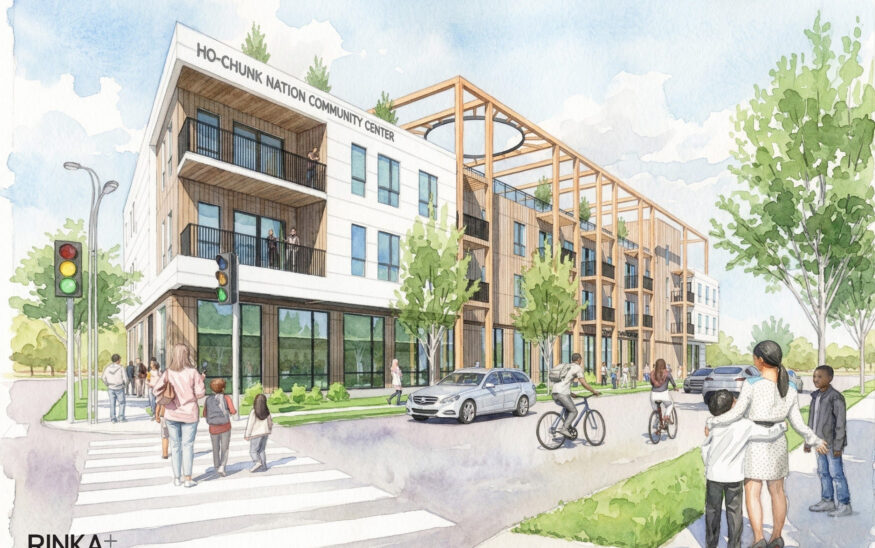
A rendering of the Ho-Chunk Nation project on Milwaukee's south side. (USA Today Network)
Ho-Chunk Nation plans to bring housing, culture under one roof
By: USA Today Network//April 21, 2026//


 Listen to this article
By FRANK VAISVILAS
USA Today Network via Reuters Connect
A $16 million building project by Ho-Chunk Nation on Milwaukee‘s south side could bring much needed housing and cultural space.
The half-acre site at 3501 S. Howell Ave., is the current location of the tribe’s community center and Milwaukee branch office, where educational programming and Ho-Chunk language classes are held. About 336 Ho-Chunk tribal members live in Milwaukee County.
“It’s been functional, but it’s just not an efficient space,” said Collin Price, who’s developing the project.
Price is a Ho-Chunk tribal member who’s developed several previous tribal projects. He is the managing partner of Revel49, a real estate company that is part of Revel Investments. Price pitched Ho-Chunk officials on the idea of the development about three years ago, and Revel49 is now poised to develop the project on behalf of the tribe. The company was born with the idea of advancing Indigenous communities with environmentally conscious projects.
The plan is to demolish the current one-story building and replace it with a three-story building that would have about 40 one- and two-bedroom residential units on the upper floors and cultural spaces on the ground level.
Rather than one large reservation, which most other tribes have in the state, the Ho-Chunk Nation has small communities and manages tribal trust lands in Wisconsin (especially Milwaukee), Illinois (especially the Chicago area) and Minnesota.
Price said the tribe tries to provide services to all those communities where they are and typically purchases existing buildings to house those services.
“What’s cool about this (project) is it is being designed for our own use,” he said.
The Milwaukee-based RINKA architectural firm is designing the project and has been meeting with Ho-Chunk representatives to incorporate cultural and symbolic elements into and around the building.
The cultural spaces will include areas for traditional beading, basketmaking, tanning hides and other activities. The rooftop will include a firepit for ceremonies, such as burning prayer messages for Creator.
“The approach here is to do as much as we can with as little as possible,” Price said.
Price said the plan also is for the building to include a library space featuring Indigenous authors and a demonstration kitchen showing people how to prepare Indigenous foods.
“We’re developing this project from an Indigenous lens,” he said.
Price said the building will feature “green” technology, such as a highly efficient HVAC that recycles warm air.
Implementation of the project is currently dependent on whether it wins a low-income housing tax credit award from the Wisconsin Housing and Economic Development Authority. The award will be announced sometime in May.
Developments that receive tax credits typically must offer at least 85% of a building’s apartments at below-market rents to people earning no higher than 60% of the area’s median income. Developers often sell the tax credits to raise equity cash for their projects and then use bank loans and other sources to complete their financing packages.
“Low-income housing tax credits will contribute the bulk of the capital stack,” Price said. “The Ho-Chunk Nation will source the remaining funds through a mix of debt and equity.”
If the tribe isn’t awarded the tax credits, Price said, it will re-examine the project.
“Ultimately, we could explore a stand-alone community center without the housing while we look at other sites in the Milwaukee metro area for housing,” Price said.
The Wisconsin Housing and Economic Development Authority also offers a non-competitive tax credit option for developers to apply for, which could subsidize up to 30% of a project’s cost.
If the project moves forward, Price said his firm would provide construction opportunities for Indigenous contractors. Housing would be available to Ho-Chunk tribal members as well as qualifying members of the general public. An opening would be targeted for late 2027.
Tom Daykin contributed to this report.
Related Articles

Related Content


Polls
 Loading ...
Today’s News
- Ho-Chunk Nation plans to bring housing, culture under one roof
- TOP BIDDERS: The biggest recent winning bids from around Wisconsin | April 21
- Builders urge mandate for home production as supply dries up in Wisconsin
- Proposed Wisconsin Rapids data center to be discussed in May
- Wisconsin announces $117M for local roads
- She Builds Wisconsin returns in 2026 to capture girls’ interest in construction
- Marquette professor wins Milek Fellowship with ‘Goldilocks’ solution to an earthquake engineering problem
- Big Bend planners recommend permit for athletic complex’s 1st phase
- Wisconsin Pre-Bid Meetings – Week of April 20, 2026
- $3M commitment boosts Milwaukee plan for nearly 100 affordable homes
- Where Wisconsin governor candidates stand on data center construction
- Marshfield plans $7.6 million youth center at former J.C. Penney building






Project Profiles
- First prefabricated bridge in US installed in Eau Claire County
- Illinois developer worked with Wisconsin contractor to build 258-unit Wauwatosa apartment complex
- VJS Construction raises the roof for Bruce Guadalupe Community School expansion project
- Microgrid pilot project will store energy for village affected by outages
- Dane County sees uptick in highway work zone crashes, on track to exceed last year
- The Hop streetcar will debut newest service route in fall with limited service
- FPC Live slims venue proposal to 1 downtown building
- Children’s Hospital urgent care center in Milwaukee gets first round of city approval
- With Sonag Construction shut down, feds move to block indicted owner from collecting leftover assets
- Four contractors selected to build border wall prototypes
- UW-Milwaukee’s Greenstreet shaping minds (and the city)
- Turning the Corner(s) (PHOTO SLIDESHOW)