


 Free Newsletter

Critics fume over diesel generator health concerns at AI data center
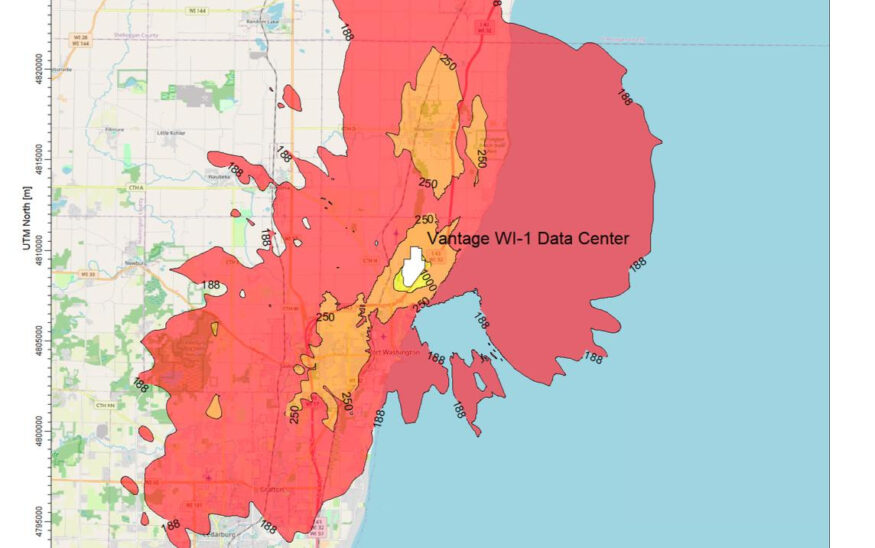
Midwest Environmental Advocates hired engineering firm Wingra to review the diesel generators' compliance with one-hour national standards for nitrogen oxides. The analysis found the generators could exceed those standards within a 10-mile of the data center campus. (USA Today Network)
Critics fume over diesel generator health concerns at AI data center
By: USA Today Network//April 23, 2026//


By CLAUDIA LEVENS
USA Today Network via Reuters Connect
Neighbors of Port Washington‘s $15 billion AI data center and advocacy groups are voicing public health and environmental concerns about plans for backup diesel generators at the site under review by Wisconsin regulators.
They’re also asking Wisconsin’s Department of Natural Resources for a more robust analysis of the entire project, but especially of the diesel generators, after the agency signaled it’s likely to approve air quality permits for them.
The data center’s developer and operator, Vantage, submitted permitting requests to the DNR for 45 diesel-fired backup generators that would provide a combined 87 megawatts during grid failures, according to applications submitted in August and September of 2025, shortly after officials in the City of Port Washington signed a development agreement.
Construction on the data center is well underway, and it will soon house OpenAI and Oracle, which will leverage the site to advance artificial intelligence.
Diesel generators are pickup-truck-sized power sources, often used as emergency energy backstops for when the grid fails, especially at large commercial and industrial facilities that run around the clock. More frequently, that includes hyperscale data centers. Wisconsin is a hub for diesel generator manufacturing and distribution; it’s the home of several industry players, such as Generac Power Systems.
But diesel generators also produce pollutant byproducts known to affect the environment and cause or exacerbate health problems, especially when several of them are used in full force, according to the United States Environmental Protection Agency.
Those concerns were at the center of an April 14 virtual public hearing held by the DNR as part of its review of Vantage’s request.
Dozens spoke at the hearing, including neighbors of the site, environmental advocates and public health experts, and even more submitted written comments. In total, almost 550 people spoke or sent comments to the DNR.
Almost all urged the DNR to more thoroughly review the plans and reconsider a preliminary determination issued Feb. 26, which states the generators’ emissions would not surpass state and federal air quality standards. Collectively, they criticized the DNR’s review, emphasized health concerns and asked for reasonable safeguards to protect neighbors.
The DNR is expected to issue a final determination on the roughly $11,000 permit within the next several weeks.
Environmental advocates say DNR’s policies for backup generator reviews obfuscate public health risks
One of diesel generators’ pollutants at the center of concern for neighbors and environmental advocates is nitrogen oxide. In excess, nitrogen oxides can cause or exacerbate respiratory and cardiovascular diseases, according to the EPA. The International Agency for Research on Cancer has classified diesel exhaust, which includes nitrogen oxides, as a Group 1 carcinogen since 2012.
Nitrogen oxide emissions react with sunlight to form ozone and the reddish-brown haze of smog in the air, as well as with water to contribute to acid rain conditions, according to the EPA. These pollutants are also in emissions from cars, trucks, buses and other kinds of power sources.
National air quality standards set two upper limits for nitrogen oxide concentration: one established in 1971 that averages the pollutant over a year, and another established in 2010 that examines the pollutant over a one-hour period.
The DNR did analyze potential nitrogen oxide from Vantage’s proposed generators averaged over one year. The agency concluded that emissions would fall below one-year limits established by National Ambient Air Quality Standards, according to the DNR’s preliminary determination.
That analysis derives from proposed limits on the amount of fuel Vantage would use, roughly 324,000 gallons each year, per the DNR’s preliminary determination. However, it’s worth noting federal regulations do not place any limits on diesel generator use during emergencies.
However, the DNR did not model nitrogen oxide during a one-hour period to assess the pollutants’ concentration during an emergency situation – one that would require simultaneous use of all 45 diesel generators.
But Midwest Environmental Advocates did.
According to a written statement submitted to the DNR during the public comment period, the nonprofit law center hired the engineering firm Wingra to assess compliance with one-hour NAAQS limits for nitrogen dioxide and other pollutants associated with diesel generators.
MEA’s analysis found that the simultaneous use of the Vantage generators could exceed those standards within a 10-mile radius of the data center campus in Port Washington. That radius would include the communities of Fredonia, Saukville, Belgium, Cedar Grove and Grafton – a large swath of Ozaukee County.
So exactly how much nitrogen oxide would the generators emit?
According to MEA’s analysis, the generators could emit over 2,407 pounds of nitrogen oxide per hour during full emergency use. For comparison, that’s roughly 37 times as much nitrogen oxide as is produced by the gas-fired, 1.15-gigawatt We Energies power plant in the City of Port Washington.
The DNR and MEA differ in their views of whether a one-year or one-hour modeling is an appropriate benchmark.
The DNR’s preliminary determination cites a 2018 agency policy that says emergency generators are not good candidates for short-term nitrogen oxide dispersion modeling because emergency generators run intermittently.
But to MEA Legal Fellow Michael Greif, the DNR’s analysis averaging pollutants over an entire year dilutes the intensity of emissions during use, however intermittent.
“It’s not a reasonable way to view this,” Greif said. “Most of the time it’s not going to be emitting anything. But then sometimes, it’s going to be emitting huge amounts of nitrogen oxides, which will still have impacts on peoples’ health and is why it has short-term, one-hour standards.”
Greif argued the 2018 policy is outdated, predating the proliferation of hyperscale data centers, and doesn’t account for the intense bursts of pollutants that would be emitted during emergency use.
The DNR did not respond to questions sent by the Milwaukee Journal Sentinel on April 13 and April 21.
But at the public hearing on April 14, a spokesperson for the DNR said the agency would look into concerns raised by speakers, as part of its ongoing review.
Vantage said it intends to comply with permit parameters and air quality standards
In an April 22 statement sent to the Journal Sentinel, Vantage Vice President of Global Marketing Mark Freeman said the company takes air quality seriously and is reviewing recommendations raised in public comments.
Freeman also emphasized the intermittent nature of the generators, along with their primary use for emergencies, and he said the company intends to comply with both the permit’s operating limits and all other applicable air quality standards.
“Our standard operational and maintenance needs for emergency back-up generators are significantly below the current estimated annual operational limits established in the draft Air Pollution Control Permit issued by the [DNR] (assuming the grid remains stable and reliable),” Freeman said.
Air quality and environmental impacts at the center of neighbors’ concerns
Over the course of Christine Le Jeune’s life, she’s endured two open heart surgeries due to a congenital heart condition.
Le Jeune lives near the data center site and is a founding member of a grassroots data center opposition group in Port Washington, Great Lakes Neighbors United, which is challenging the project in court and at the polls.
At the April 14 hearing, she said she’s highly concerned for her health and the health of her neighbors, especially those who also have pre-existing conditions. She already struggles with poor air quality in Ozaukee County, which is classified under federal standards as an ozone non-attainment area.
That means the county is already failing to meet the EPA’s standards for healthy levels of ground-level ozone.
She and several other speakers asked the DNR to conduct a more thorough analysis of the generators and a deeper environmental review of the project as a whole.
“The community really needs to be taken into greater consideration,” Le Jeune said. “You cannot just average that away.”
Carri Prom, a nurse practitioner who also helped found Great Lakes Neighbors United, laid out the health impacts of diesel exhaust and pleaded for the DNR to deny the permit.
“I have sat with patients whose lives were shaped by preventable exposures,” Prom said. “I am asking you not to add to that list.”
“We should not have to pay with our health for a billion-dollar company’s profit,” she added. ” We should not have to beg a regulatory agency to do its job. And our children should not inherit an earth we failed to protect.”
Sheboygan resident Rebecca Clark said she blamed state legislators for deploying inadequate funding, staff and resources for air management at the DNR.
Racine resident Gloria Randall-Hewitt said the decision could have ramifications for the entire state. As one of the first air quality permits for a hyperscale data center under review by the DNR, she feared it could set a lax precedent for future projects.
Several speakers expressed consternation at the level of construction Vantage has reached at the site without the permits issued.
Others who submitted comments included comedian and anti-data center advocate Charlie Berens, representatives from Healthy Climate Wisconsin (a statewide organization of health professionals), Milwaukee County Supervisor Felesia Martin, Milwaukee philanthropist and Schlitz Brewing Company heiress Lynde Uihlein and Clean Wisconsin.
A Clean Wisconsin analysis published April 14 projected that emissions from Vantage’s generators, particularly increased ozone, could rack up between $960,000 to $1.29 million in annual public health costs.
Environmental advocates say Vantage’s request lacks technology to protect nearby residents
MEA argues there are reasonable ways to dilute pollutants from diesel generators.
Some projects use what’s known as selective catalytic reduction, which use a liquid-reduction agent to limit pollutants by roughly 90%.
But they’re not required for emergency diesel generator projects like this one and are not included in Vantage’s plans. They’re also not requested in the DNR’s preliminary determination.
MEA’s comments at the public hearing specifically requested this technology to protect nearby residents from pollutants.
The group’s comment notes that Microsoft plans to include selective catalytic reduction for diesel generators at its Mount Pleasant data centers, and Vantage has planned for them at its other data centers, including one in Quincy, Washington.
“This isn’t an unfathomable ask,” Greif said.
Related Articles

Related Content




Today’s News
- Sheboygan TID proposal targets public incentives of $5M or more
- TOP BIDDERS: The biggest recent winning bids from around Wisconsin | July 21
- State warns of workers’ compensation scam targeting victims
- Washington County housing initiative brings back young homeowners
- South Milwaukee apartment project canceled after financing shortfall
- Governor candidate supports moratorium for future data centers
- Wausau Equipment facility changes hands in New Berlin
- Wisconsin Laborers union backs Crowley in governor’s race
- Lt. Gov. Sara Rodriguez drops out of governor’s race
- Home construction planned for former Manitowoc mall site
- Local costs a factor in I-794 removal proposal
- Wisconsin Pre-Bid Meetings – Week of July 20, 2026








Project Profiles
- First prefabricated bridge in US installed in Eau Claire County
- Illinois developer worked with Wisconsin contractor to build 258-unit Wauwatosa apartment complex
- VJS Construction raises the roof for Bruce Guadalupe Community School expansion project
- Microgrid pilot project will store energy for village affected by outages
- Dane County sees uptick in highway work zone crashes, on track to exceed last year
- The Hop streetcar will debut newest service route in fall with limited service
- FPC Live slims venue proposal to 1 downtown building
- Children’s Hospital urgent care center in Milwaukee gets first round of city approval
- With Sonag Construction shut down, feds move to block indicted owner from collecting leftover assets
- Four contractors selected to build border wall prototypes
- UW-Milwaukee’s Greenstreet shaping minds (and the city)
- Turning the Corner(s) (PHOTO SLIDESHOW)