


 Free Newsletter

Supply shortages and emboldened workers: A changed economy
By: Associated Press//December 17, 2021//


By PAUL WISEMAN and DEE-ANN DURBIN
AP Business Writers
Employees at a fast-food restaurant in Sacramento, California, exasperated over working in stifling heat for low wages, demanded more pay and a new air conditioner — and got both.
Customer orders poured in to an Italian auto supplier, which struggled to get hold of enough supplies of everything from plastic to microchips to meet the demand.
A drought in Taiwan magnified a worldwide shortage of computer chips, so vital to auto and electronics production.
The global economy hadn’t experienced anything like this for decades. Maybe ever. After years in which ultra-low inflation had become a fixture of economies across the world, prices rocketed skyward in 2021 — at the grocery store, the gasoline pump, the used-car lot, the furniture store. Chalk it up to a surprisingly swift and robust economic recovery from the pandemic recession, one that left suppliers flat-footed and hampered by COVID-19 disruptions.
U.S. workers, having struggled for years to achieve economic gains, secured better wages, benefits and working conditions — and the confidence to quit their jobs if they didn’t get them.
Global supply chains that ran efficiently for years broke down as factories, ports and freight yards buckled under the weight of surging orders.
Propelled by vast infusions of government aid and the widespread distribution of COVID vaccines, the economic bounce-back was as startling as the fall that had preceded it. Policymakers, business owners and economists were caught off-guard by both the speed of the recovery and the new COVID variants that threatened its durability.
They had never, after all, had to manage the unpredictable fallout, economic and otherwise, from a global pandemic.
___
BACK FROM THE BRINK
In the spring of 2020, the global economy appeared to stand on the brink of a catastrophe. The sudden and blindingly fast spread of COVID-19 infections forced lockdowns, frightened people into hunkering down at home, paralyzed travel and ordinary business activity and led employers to slash tens of millions of jobs.
In June that year, the International Monetary Fund predicted that the global economy would shrink 4.9% for the year, the first drop in worldwide economic output since the 2008-2009 financial crisis.
But the governments of the wealthiest nations, scarred by the achingly slow recovery from the financial crisis just over a decade earlier, poured money into rescuing their economies. The United States was particularly aggressive: It supplied $5 trillion in COVID-related stimulus aid to individuals, businesses and municipalities this year and last.
“The U.S. has been a total outlier globally,” said Robin Brooks, chief economist at the Institute of International Finance, a global trade group for financial companies.
“We had the deepest pocketbook of any country. We have this exorbitant privilege” — the ability to run up debts to pay for COVID relief without having to pay high interest rates to do so. Global investors regard U.S. government debt as perhaps the safest investment around; their purchases of U.S bonds keep American interest rates low.
So despite immense federal spending and surging inflation, the yield on the benchmark 10-year Treasury note — below 1.4%, as of early Friday — remains lower than it was before the pandemic.
In the United States and elsewhere, stimulus aid is widely credited with helping stave off disaster. Although the global economy did shrink in 2020, it did so by a less-than-expected 3.1%. And the IMF expects growth to rebound to 5.9% for 2021. That would be the fastest calendar-year expansion in IMF records dating to 1980.
Beginning earlier this year, vaccines accelerated the return to something much closer to ordinary pre-pandemic life.
“We got this scientific miracle,” said Jacob Kirkegaard, senior fellow with the German Marshall Fund of the United States. “We had a vaccine that was available six to nine months earlier than anybody had really believed in 2020 …
What that meant was that the second half of 2021 saw basically a general reopening in all of the advanced economies, and that was certainly was a massive positive surprise.”
___
COVID UNCERTAINTY
Still, the virus itself has continued to complicate anyone’s ability to forecast where the economy was headed or to determine what to do about it. A wave of infections over the summer, for instance, sent Japan’s economy into a nasty tailspin: It shrank from July through September at a 3.6% annual rate.
Likewise, America’s recovery lost momentum once the highly contagious delta variant erupted over the summer. Growth slowed to a 2.1% annual rate from July through September, sharply down from a 6.7% rate in the April-June quarter and 6.3% in the January-March period.
Overall, though, the economy has recovered with surprising vigor. In June 2020, with the economy still reeling from the pandemic, the Federal Reserve’s policymaking committee forecast that unemployment would average 9.3% in the final three months of the year and 6.5% at the end of 2021. In reality? The jobless rate plummeted from 11.1% in June 2020 to 6.7% by year’s end. It’s now at a near-fully healthy 4.2%.
Flush with government payments and, in many cases, savings accrued from working at home and from stock-market gains, people in rich countries were sitting on larger piles of cash and spending a lot of it.
Capital Economics calculates that households in advanced economies like the United States and the European Union were holding “excess savings” at mid-year of $3.7 trillion — the amount above what they would likely have saved if the pandemic had never happened.
___
THE PAIN OF HIGH PRICES
The supply chain bottlenecks have driven up costs, contributing to a problem that most rich countries hadn’t had to endure for years: Persistently high inflation. The IMF expects consumer prices in advanced economies to rise 2.8% this year. That would be the highest such rate since 2008.
Soaring energy prices, a response to the brisk economic recovery, contributed mightily to the runup in prices. The price of the U.S. benchmark crude skyrocketed 75% — to $84 a barrel — from January through October, before easing in recent weeks as the omicron variant raised the prospect of slower growth.
Inflationary pressures were especially intense in the United States. In addition to energy, some of the largest cost spikes were for such necessities as food, housing, autos and clothing — goods and services that millions of Americans regularly depend upon. Especially hard hit were lower-income households with little or no cash cushions. Last month, U.S. consumer prices shot up 6.8% from 12 months earlier — the biggest year-over-year increase since 1982.
Over the past year, used-car prices surged 31%, beef roast 26%, men’s suits and coats 14%. And price hikes are outpacing wage gains. After inflation, U.S. workers’ hourly earnings, despite pay increases, were actually down 1.9% last month compared with November 2020.
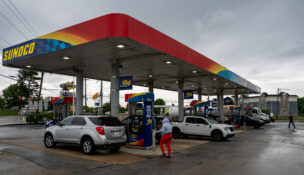
At a Mobil station in Yonkers, New York, a gallon of regular gas was selling for $3.89. Mario Bodden, a project manager at a nearby mall, said it cost $50 to fill up, instead of the $35 he was used to.
“You start thinking: Do I go shopping? Do I fill it up today?” Bodden said. “Every trip is planned and targeted. So there’s a lifestyle change.”
“We still have to do what we have to do to survive,” Ray Khoury, a hospital administrator, said as he filled up a Mercedes at a BP station in Yonkers. “The everyday needs of your families, your kids — it trickles down. Forget about savings. Savings are shot.”
___
A MADE-IN-AMERICA LABOR SHORTAGE
Even while absorbing higher prices, workers, especially in America, were benefiting from a tighter labor market that gave them leverage to secure better pay and benefits. With many white collar employees able to work from home, companies found that their staffs didn’t need to commute to the office to do their jobs. That meant that workers could spend more time at home and save money they would have spent on parking, commuting and lunches out.
The United States, in particular, experienced acute labor shortages. At the depths of the pandemic recession in the spring of 2002, employers had slashed 22 million jobs. As the economy recovered, they refilled more than 18 million jobs — and complained that they couldn’t find enough workers.
In September and October, employers listed 1.4 job openings for every unemployed American, the most in records going back 15 years. That marked a striking reversal from April 2020, in the depths of the coronavirus recession, when there were just 0.2 openings for each unemployed person — or, stated another way, when there were five unemployed people for every available job.
A rise in early retirements, a shortage of affordable child care, the reluctance of many restaurant workers to return and a drop in immigration contributed to the labor shortage. The government also expanded unemployment aid and gave relief checks to households, bolstering their savings and allowing the jobless to be choosier about their next employer.
American workers, as a whole, were hardly afraid to change jobs: 4.2 million of them quit in October, just off the all-time record of 4.4 million, set one month earlier.

Related Content





Polls
 Loading ...
Today’s News
- Judge halts tree clearing at Potawatomi State Park
- Groundbreaking set for $16M NeuVue mixed-use development in Milwaukee
- Architecture billings score low, but Wisconsin firms remain busy
- Wisconsin Pre-Bid Meetings – Week of June 29, 2026
- Meta, ABC partner on construction career academy amid data center boom
- The Gund Co. plans 110,000-square-foot expansion in Waukesha
- Milwaukee airport Amtrak project cost doubled since groundbreaking
- Tech giant sues Wisconsin regulator over data center restrictions
- World’s most powerful supercomputer project completed in Wisconsin
- Waukesha to consider final site plan for INNIO expansion
- New Land Enterprises proposes 25-story Milwaukee condo tower
- Civil engineering firm moves into new Cedarburg office







Project Profiles
- First prefabricated bridge in US installed in Eau Claire County
- Illinois developer worked with Wisconsin contractor to build 258-unit Wauwatosa apartment complex
- VJS Construction raises the roof for Bruce Guadalupe Community School expansion project
- Microgrid pilot project will store energy for village affected by outages
- Dane County sees uptick in highway work zone crashes, on track to exceed last year
- The Hop streetcar will debut newest service route in fall with limited service
- FPC Live slims venue proposal to 1 downtown building
- Children’s Hospital urgent care center in Milwaukee gets first round of city approval
- With Sonag Construction shut down, feds move to block indicted owner from collecting leftover assets
- Four contractors selected to build border wall prototypes
- UW-Milwaukee’s Greenstreet shaping minds (and the city)
- Turning the Corner(s) (PHOTO SLIDESHOW)