


 Free Newsletter

NEC clarifies 83% rule for single-family dwelling conductors

Mark Cook is an electrical education specialist and master electrician at Faith Technologies. He has been in the electrical industry since 1978 and owned an electrical contracting business from 1994 to 2015 in Arizona until his recent employment with Faith Technologies as a technical training consultant. He now provides CEU classes and exam prep class, as well as Arc Flash training, for Faith. He can be reached at [email protected].
NEC clarifies 83% rule for single-family dwelling conductors
By: BridgeTower Media Newswires//June 22, 2026//


In the 2026 National Electrical Code, a slight revision was made that can effect which conductor or cable assembly that can be installed in accordance with the 83% rules. The revised requirements can be found in section 310.12.
This rule permits conductors for services or feeders that serve the entire load of an individual dwelling unit to be sized at not less than 83 percent of the rating of the overcurrent protective device (OCPD). Simple math would look like this. 100-amp circuit breaker equals 83-amp copper or aluminum conductors. If you look in that section you can find Table 310.12(A) which basically does the math for us for copper or aluminum and copper-clad aluminum (CCA). This rule was introduced many years ago because of “load diversity”, which is associated with power consumption in dwellings. We all know that not every load is going to be on at the same time within a dwelling. Therefore, we are permitted to use a reduced size service or feeder conductor for the dwelling units, but only for dwelling units.
First, let us identify the basic rules for application of 310.12.
- This only applies to single-family dwelling units.
- It cannot apply to less than 100 amps but not more than 400 amps.
- It must be the entire load of a single-family dwelling unit.
- It only applied to service or feeder conductors.
- The neutral is permitted to be sized in accordance with 120.61.
For example, a 200-amp feeder to a sub-panel inside the garage supplied by a 400-amp service would not be permitted to apply the 83 percent rule with this section. As long as the service or feeder conductors serve the entire load of an individual dwelling unit, the application of the 83 percent rule is permitted. Adjustment factors and correction factors are still required if applicable. You are permitted to install a reduced neutral size in accordance with 120.61, which is 70% to the portion of the unbalanced load in excess of 200 amps. Section 120.61 was also relocated from 220.61 when Article 220 for Load Calculations was relocated to Article 120 in Chapter 1 of the 2026 NEC.
Unknowingly, some electricians may continue to making the mistake of applying this to feeders to remote subpanels within a single-family home. Even I, unknowingly, misapplied this rule to fit my installations in the past. When looking at this rule, and when only reading the Table, it can lead to confusion or misapplications. In Table 310.12(A), you will see a column for feeders. One might think, “Oh, I am installing a subpanel supplied by a feeder in a dwelling, so this Table works for me”. No, that is not accurate. In the 2017 edition of the NEC, the associated Table was relocated to Annex D, Figure D7. In 2017, this section was found in 310.15(B)(7) without the Table located within the section. There was an Informational Note that pointed to Annex D7. I feel like removing the Table from the section minimized the misapplication of the conductor sizing in my opinion. Annex D7 in the 2026 NEC has a full, comprehensive explanation of the rules including calculations.
In the 2020 National Electrical Code, this rules were relocated to 310.12 and included the Table again. The 2023 has the same requirements with not even an editorial change.
The 2026 National Electrical Code comes out with a subtle change that when applied could have significant consequences if misunderstood or misinterpreted. A sentence was added to the end of the paragraph in 310.12(A) for services and 310.12(B) for feeders. It says that this rule can only be applied to conductors rated at 75°C or greater. If installing only single conductors within raceways or using service entrance cables Type SE or SER cables, you are fine. Type MC cable is also compliant as is. But if you decide to use nonmetallic sheathed cables, Type NM (Romex) then you could be in trouble.
In section 334.80 for the ampacity of Type NM cables, it requires that the cable assembly be rated at 60°C even though the conductors have a 90°C insulation as was required for Type NM cable as far back as 1984. It was known as NM-B which was manufactured with 90°C and NM-A was made with a 60°C, Type TW, insulation and manufacturing of NM-A was eventually discontinued. You might encounter Type NM-A in existing installations. The insulation is thicker than NM-B, 90°C, insulation. Type NM-B was also required to be installed close to magnetic ballasts of older fluorescent lighting. Older fluorescent lighting fixtures had labels that required only 90°C insulated conductors within 2 inches of the ballast. NM-B was also a better cable for use in attics or close to lighting fixtures installed in the ceiling with incandescent lamps. The 90°C insulation may be used to correct and adjust the ampacities of the conductors for the conditions of use; it is still limited to the maximum ampacity as determined in the 60°C column of Table 310.16. This is in accordance with 334.80.
So instead of using a 2 AWG copper conductor in accordance with Table 310.12 for a 125-amp service or feeder to an individual dwelling unit. If using “Romex” you are required to correct the 60°C column conductor to 83%.
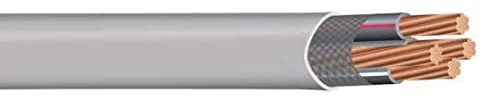
Romex is currently manufactured only as large as 2 AWG copper, aluminum, or copper-clad aluminum as per 334.100. You cannot use that cable assembly under the 60°C column, for this application of the Code. From 310.12, for a 100-amp feeder or service, a 4 AWG, copper, Type NM cable, is only rated at 70 amperes under the 60°C of Table 310.16. A 2 AWG, copper, Romex, conductor under the 60°C column is only good for 95 amperes. You would need to use at least a 1 AWG at 110 amperes and then size it at 83%, which is 91 amperes which does not exist. Because there are only two conductor sizes of Type NM cable that could be applied to use 310.12, I would not even consider it as an option. Although you could use a 2 AWG, Romex cable for a 110-amp, OCPD or a 3 AWG Romex cable for a 100-amp, OCPD. That is all folks!
In the real world, you would probably not be required to size and install the service conductors unless it was an overhead service to a dwelling unit. We would then install conductors from the meter socket to the weather head. Or the conductors installed from the meter socket to the Main. Underground conductors are typically provided and installed by the utilities. But the electrical contractor would install the feeders supplying Two-family or quadplex dwelling units and multifamily dwelling units, this rule can save money on installation costs.
Do not make the same mistakes that others make, or had made, including myself. Read the Code sections associated with any Table in the NEC. Understand the insulation temperature limits of cable assemblies located in Chapter 3. (***.80) Reach out to your local AHJ for help with compliance. Don’t forget to make adjustments and / or corrections if applicable.
Related Articles

Related Content






Today’s News
- (UPDATED) Wisconsin construction union endorses gubernatorial candidate
- Walker’s Point may get publicly financed parking structure
- $24M mixed-use development breaks ground
- Supervisor calls for referendum on Milwaukee County Courthouse revamp
- $19M mixed-use project tackles city’s biggest issues
- US existing home sales unexpectedly fall in June
- Milwaukee Water Street nightlife locations for sale
- Milwaukee mayor favors improving I-794 freeway over removal
- Wisconsin Pre-Bid Meetings – Week of July 13, 2026
- 200-unit apartment project wins 2nd city endorsement
- ON THE LEVEL: Josh Brown takes the torch at Bliffert Lumber
- BUILDING BLOCKS: Tom’s Drive In nears completion in Fond du Lac





Project Profiles
- First prefabricated bridge in US installed in Eau Claire County
- Illinois developer worked with Wisconsin contractor to build 258-unit Wauwatosa apartment complex
- VJS Construction raises the roof for Bruce Guadalupe Community School expansion project
- Microgrid pilot project will store energy for village affected by outages
- Dane County sees uptick in highway work zone crashes, on track to exceed last year
- The Hop streetcar will debut newest service route in fall with limited service
- FPC Live slims venue proposal to 1 downtown building
- Children’s Hospital urgent care center in Milwaukee gets first round of city approval
- With Sonag Construction shut down, feds move to block indicted owner from collecting leftover assets
- Four contractors selected to build border wall prototypes
- UW-Milwaukee’s Greenstreet shaping minds (and the city)
- Turning the Corner(s) (PHOTO SLIDESHOW)