


 Free Newsletter

Drilling fluid spills into wetland during Line 5 reroute construction
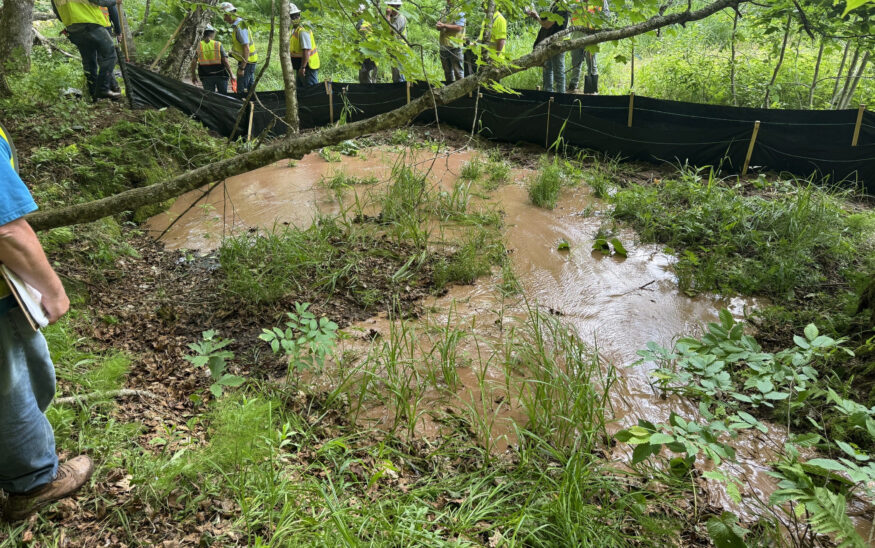
An estimated 1,600 to 1,900 gallons of drilling fluid spilled into a forested wetland on the Bad River Band’s reservation during construction of Enbridge’s Line 5 reroute on June 27, according to EarthJustice. (Earthjustice)
Drilling fluid spills into wetland during Line 5 reroute construction
By: USA Today Network//July 1, 2026//


By CAITLIN LOOBY and LAURA SCHULTE
USA TODAY Network via Reuters Connect
An estimated 1,600 to 1,900 gallons of drilling fluid has spilled into a forested wetland on the Bad River Band‘s reservation during construction of Enbridge‘s Line 5 reroute.
The frac out – also known as an inadvertent return – occurred on June 27 during horizontal drilling, a method that runs pipelines under sensitive areas, like creeks and wetlands. In the pressurized process, mud and clay can burst through the ground and spill into nearby areas.
The Bad River Band contacted the Wisconsin Department of Natural Resources on June 28 after learning of the incident, which occurred near Gurney in Iron County in the northern part of the reservation. Neither the DNR nor Enbridge had told them.
In an email to the Bad River Band, the DNR said most of the bentonite clay slurry was contained on land, but between five and eight gallons entered Vaughn Creek, which flows into Potato River and then the Bad River.
The DNR reported the spill in the wetland had been cleaned up and that monitoring would continue through June 29.
Enbridge first proposed its 41-mile reroute around the Bad River Band’s land in 2019 after the Band sued to have the original Line 5 pipeline removed from its land. The new stretch of pipeline would go farther inland, to Ashland and Iron counties, through Iron County State Forest, around Copper Falls State Park. It will cross more than 180 Lake Superior tributaries, including the Bad River. A 2021 estimate suggested it would cost $450 million.
The incident underscored long-standing fears of the Band and environmental groups, which have repeatedly warned that frac-outs and possible aquifer breaches pose serious risks, pointing to similar problems during Enbridge’s Line 3 construction in Minnesota.
“This is exactly what we were worried about,” said Bad River Band Chairwoman Elizabeth Arbuckle.
“They haven’t proved they can do this work safely,” Arbuckle said. “We should all be concerned and alarmed.”
Bentonite clay is not oil, but its release can cloud waterways and smother fish. Arbuckle is particularly worried about the potential harm to the Potato River, designated by Wisconsin as an outstanding resource waterway, which means it offers outstanding recreational opportunities, supports critical fish and wildlife habitat, and is not significantly impacted by human activities.
In an emailed statement, Enbridge spokesperson Juli Kellner acknowledged the spill and said cleanup was being handled in a preapproved way.
“Following preapproved response plans, the clay and water has been contained using sandbags and silt fence to protect the creek during the clean-up, which is well underway,” she said in a June 30 email to the Journal Sentinel. “We will continue to work with the DNR on completion of the clean-up.”
The Line 5 reroute will run through a region with highly biodiverse wetlands and one of the most ecologically rich environments in Wisconsin, said John Petoskey, senior associate attorney with Earthjustice.
Petoskey said Enbridge violated its permit by having a frac-out− a violation he said should be prosecuted or taken to court. In fact, the Band and environmental groups had asked the DNR much earlier to analyze how much clay could harm the environment in the event of a frac-out, but Petoskey said the DNR did not do that analysis.
Line 5 spill comes as litigation continues
The spill comes as Enbridge moves forward with construction of its controversial Line 5 reroute around the reservation, a project that has drawn sustained opposition and ongoing litigation.
Last October, the Army Corps of Engineers approved federal permits for the project. In a short media release, the Army Corps did not release much information about the approval, raising concerns.
Those permits were contested by Ojibwe officials in December, with a lawsuit in federal court that alleged the approvals violated the Clean Water Act and the National Environmental Policy Act because potential environmental damage and threats were not fully evaluated.
In February, a different ruling by an Administrative Law Judge upheld the permits granted by the Wisconsin DNR, allowing construction to begin. Bad River Ojibwe officials asked the Iron County Circuit Court to reconsider that ruling.
In May, an Iron County judge issued a ruling that required Enbridge to partially halt construction of the oil pipeline in four areas where it was slated to cross waterways. The judge ruled that the company will be required to attain additional permits for any construction in those waterways. Construction in other places is still moving forward.
The June frac-out is why environmental groups are calling for construction to be halted while the litigation plays out, Petoskey said.
In 2023, U.S. District Judge William Conley ordered Enbridge to shut down or reroute Line 5 around the Bad River reservation by mid-June 2026 and to pay $5.15 million for trespassing on tribal land. Both Enbridge and the tribe appealed.
In March, Conley put that shutdown order on hold while a federal appeals court weighs the case, warning a sudden shutdown could be devastating.
The appeals court has not yet ruled.
Related Articles

Related Content





Today’s News
- Worker files NLRB complaint against Wisconsin painters union
- Lawsuit challenges Wisconsin Supplier Diversity Program
- Sheboygan TID proposal targets public incentives of $5M or more
- TOP BIDDERS: The biggest recent winning bids from around Wisconsin | July 21
- State warns of workers’ compensation scam targeting victims
- Washington County housing initiative brings back young homeowners
- South Milwaukee apartment project canceled after financing shortfall
- Governor candidate supports moratorium for future data centers
- Wausau Equipment facility changes hands in New Berlin
- Wisconsin Laborers union backs Crowley in governor’s race
- Lt. Gov. Sara Rodriguez drops out of governor’s race
- Home construction planned for former Manitowoc mall site







Project Profiles
- First prefabricated bridge in US installed in Eau Claire County
- Illinois developer worked with Wisconsin contractor to build 258-unit Wauwatosa apartment complex
- VJS Construction raises the roof for Bruce Guadalupe Community School expansion project
- Microgrid pilot project will store energy for village affected by outages
- Dane County sees uptick in highway work zone crashes, on track to exceed last year
- The Hop streetcar will debut newest service route in fall with limited service
- FPC Live slims venue proposal to 1 downtown building
- Children’s Hospital urgent care center in Milwaukee gets first round of city approval
- With Sonag Construction shut down, feds move to block indicted owner from collecting leftover assets
- Four contractors selected to build border wall prototypes
- UW-Milwaukee’s Greenstreet shaping minds (and the city)
- Turning the Corner(s) (PHOTO SLIDESHOW)