


 Free Newsletter

Microsoft will work on $4 billion addition to data center in Mount Pleasant

An air- and water-cooling system at the Microsoft data center facility in Mount Pleasant. (Photo courtesy of Microsoft)
Microsoft will work on $4 billion addition to data center in Mount Pleasant
By: Ethan Duran//September 18, 2025//


THE BLUEPRINT:
- Microsoft to build a $4 billion, additional AI data center in Mount Pleasant.
- The company’s total investment in Wisconsin reached around $7.3 billion.
- The facility is touted as world’s most powerful AI data center.
- Environmental groups raised concerns over water and energy use.
A tech giant’s footprint will expand in Racine County.
Microsoft on Thursday announced it will build a $4 billion advanced artificial intelligence data center in Mount Pleasant over the next three years, which will be similar in size and scale to the initial $3.3 billion facility set to be operational in 2026. The company’s total Wisconsin investment has reached roughly $7.3 billion.
“We’re in the final phases of building Fairwater, the world’s most powerful AI data center in Mount Pleasant, Wisconsin — part of a region forged by generations of hard work and ingenuity,” wrote Brad Smith, vice chair and president of Microsoft, in an announcement.
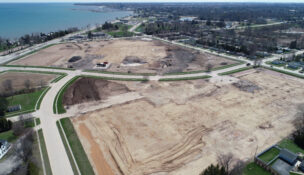
In May 2024, Microsoft announced its first data center complex in southeastern Wisconsin, which included a visit from former President Joe Biden. The company initially planned a 1.5 million-square-foot data center on land formerly set aside for Taiwan-based Foxconn Technology Group.
Foxconn’s plans didn’t come to fruition, but companies such as Boldt and Walsh Construction are building out the data center complex on land Microsoft bought.
The facility will hold “hundreds of thousands” of powerful NVIDIA general processing units, which will be used to train AI models. Smith said this will deliver “ten times the performance of today’s fastest supercomputers.” Microsoft officials said the Mount Pleasant facility will be the world’s most powerful AI data center.
“But what does that mean for the average Wisconsinite?” Smith wrote. “It means new jobs, new skills and new opportunities — right here at home. From union construction roles to long-term careers in operations and IT, this facility is creating pathways for Wisconsinites to be part of the future of technology. It means students at Gateway Technical College can train for high-demand roles through Wisconsin’s first Datacenter Academy. It means local companies – from manufacturers to startups – can partner with Microsoft engineers to turn AI ideas into real solutions.”
More than 90% of the facility will use a closed-loop liquid cooling system which will be filled during construction and continuously recirculated, officials said. The rest will use outside air for cooling and switch to water on the hottest days to minimize environmental impact, officials added.
Microsoft will pre-pay for energy and electrical infrastructure to offset costs for ratepayers and match kilowatt hours used by fossil fuel with renewables, officials said. A 250-megawatt solar project under construction in Portage County will help with matching, officials said.
The first data center used more than 3,000 construction workers at its peak, Microsoft officials said. When the first data center is open, it will hire around 500 full-time employees and will grow to 800 when the second is completed.
“Throughout our history, innovation has been the key to Wisconsin’s success, championing ideas of discoveries that have transformed people’s lives the world over, and this announcement is no different,” said Gov. Tony Evers in a statement. “Microsoft’s investment puts Wisconsin on the very cutting edge of AI power, not just in the U.S., but throughout the world, while creating good, family supporting jobs, growing our communities and bolstering our critical biohealth, personalized medicine and advanced manufacturing sectors here at home. We are grateful for Microsoft’s continued investment in our state and look forward to continuing to partner together to support Wisconsin’s workforce, economy and communities.”

Announcement made as first data center goes under environmental scrutiny
Microsoft’s data center will use 8.4 million gallons each year, data from the city of Racine showed.
In February, Milwaukee Riverkeeper requested information from the city under public records. Later, the Midwest Environmental Advocates filed a lawsuit against the city to turn over project water use information. Racine’s water utility will provide Lake Michigan water for the data center campus under an agreement with Racine and Mount Pleasant.
The facility will hit peak daily use of 234,000 gallons of water each day when its first phase is completed in 2026, city data showed.
After future phases, the data center will use 702,000 gallons of water each day or 8.44 million gallons each year. This project is for when Areas 3B, 3A and 2 are built out.
The first phase (Area 3B) will see wastewater discharge of up to 81,000 gallons per day and more than 2 million each year. After all phases, the facility will discharge 243,000 gallons each day and more than 6 million each year.
“Data centers will have major implications for Wisconsin’s environment,” said Cheryl Nenn, lead at Milwaukee Riverkeeper. “Our ability to understand the impacts and protect our water resources depends on open and transparent government.”
The request “required additional review while the city worked with Microsoft and associated parties to ensure that the release of information would not violate contractual agreements,” wrote city of Racine officials. Officials pointed to the review for the delay and said their ultimate goal was transparency.
“Open and transparent government is not optional; it is essential to public trust,” said Racine Mayor Cory Mason in a statement. “While we needed time to ensure that we handled this request responsibly and in compliance with legal agreements, we believe transparency is paramount. The information has been released, and we remain committed to making all relevant government records accessible so our community can see how decisions are made and resources are used.”
In 2018, the Wisconsin Department of Natural Resources approved the city of Racine to divert up to 7 million gallons each day towards the former Foxconn site in Mount Pleasant.
The diverted water would be returned to the Great Lakes Basin through the Racine Wastewater Treatment Plant, DNR officials said.
The approval was granted under the Great Lakes – St. Lawrence River Basin Water Resources Compact, which banned diversions of Great Lakes water with a few exceptions, officials said. One exception was to allow a “straddling community” to receive Lake Michigan water if certain criteria were met. Mount Pleasant is classified as such a community.
The Microsoft data center in Mount Pleasant and Vantage Data Centers facility in Port Washington would require a combined 3.9 gigawatts of electricity, a September analysis by Clean Wisconsin found. That’s enough to power 4.3 million Wisconsin homes. However, there are only 2.8 million housing units in the state, U.S. Census data showed.
Mount Pleasant and Port Washington data centers were two of five proposed data center projects which publicly shared their electricity needs. Proposals are underway for Beaver Dam, Vienna and Red Cedar.
“To put this in perspective, that is more than three times the power production capacity of Wisconsin’s Point Beach nuclear reactor,” said Paul Mathewson, science program director at Clean Wisconsin. “And because only two of the data center projects have disclosed their power needs, we know this is really just a fraction of what the energy use would be if all those data centers are ultimately built.”
Related Articles

Related Content





Today’s News
- Wisconsin lawmaker accepts award for helping pass DACA bill
- Plans for $107M Wauwatosa library gain momentum
- Trump signs additional tariffs on Canadian steel, aluminum and lumber
- Wisconsin Pre-Bid Meetings – Week of July 27, 2026
- Feds commit $5B to AI-powered research for construction
- Worker files NLRB complaint against Wisconsin painters union
- Lawsuit challenges Wisconsin Supplier Diversity Program
- Sheboygan TID proposal targets public incentives of $5M or more
- TOP BIDDERS: The biggest recent winning bids from around Wisconsin | July 21
- State warns of workers’ compensation scam targeting victims
- Washington County housing initiative brings back young homeowners
- South Milwaukee apartment project canceled after financing shortfall








Project Profiles
- First prefabricated bridge in US installed in Eau Claire County
- Illinois developer worked with Wisconsin contractor to build 258-unit Wauwatosa apartment complex
- VJS Construction raises the roof for Bruce Guadalupe Community School expansion project
- Microgrid pilot project will store energy for village affected by outages
- Dane County sees uptick in highway work zone crashes, on track to exceed last year
- The Hop streetcar will debut newest service route in fall with limited service
- FPC Live slims venue proposal to 1 downtown building
- Children’s Hospital urgent care center in Milwaukee gets first round of city approval
- With Sonag Construction shut down, feds move to block indicted owner from collecting leftover assets
- Four contractors selected to build border wall prototypes
- UW-Milwaukee’s Greenstreet shaping minds (and the city)
- Turning the Corner(s) (PHOTO SLIDESHOW)