


 Free Newsletter

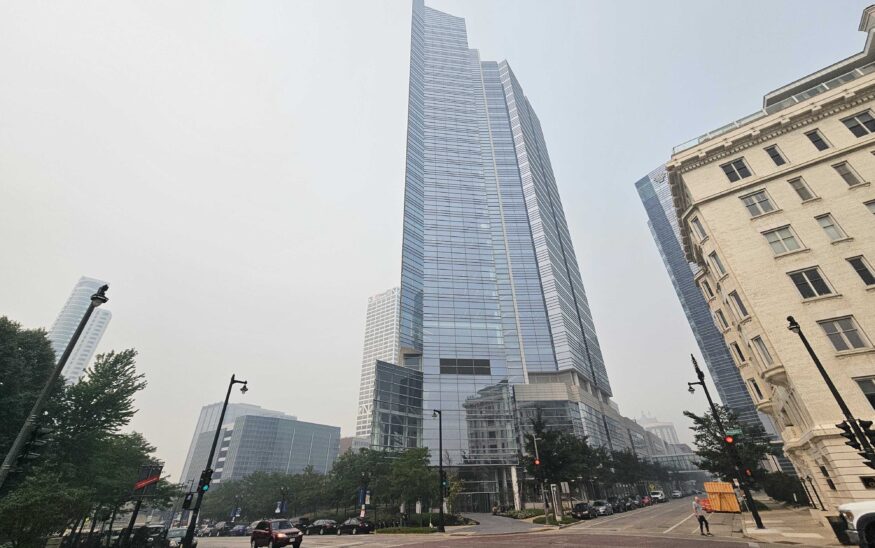
Haze billows around the Northwestern Mutual Life Insurance Co. Tower and Commons in downtown Milwaukee on July 16, 2026. (Ethan Duran)
Hazy conditions continue Thursday and Friday in Wisconsin
By: Ethan Duran//July 16, 2026//


With a smoky haze and wood fire smells, wildfire smoke from Ontario, Canada and Minnesota has shrouded parts of Wisconsin. With the National Weather Service issuing an air quality alert for much of the state, contractors are advised to adjust their schedules and use protection to avoid health risks from working outdoors.
Particles carried by smoke from the west are expected to reach hazardous levels in dozens of Wisconsin communities from early Thursday through noon Friday, NWS reported. However, the Wisconsin Department of Natural Resources expects smoky conditions to linger in the eastern part of the state.
Everyone is advised to avoid physical activity outdoors, as particle levels will pose risks especially for people with asthma and heart disease.
The American Heart Association warns wildfire smoke exposure poses an increased risk for heart disease, as several studies linked smoke exposure to an increased risk of cardiac arrest.
The Associated General Contractors of Wisconsin made a special alert during elevated temperatures and poor air quality conditions statewide.
“We encourage all contractors and jobsite supervisors to closely monitor weather and air quality conditions throughout the day and take appropriate measures to protect employees working outdoors,” AGC-WI officials said.
High heat combined with poor air quality can increase the risk of heat-related illness, respiratory distress, and fatigue, particularly for workers engaged in strenuous physical activity, officials added.
AGC shared the following safety protocols:
Monitoring and Communication
- Contractors should stay informed and consider monitoring the Environmental Protection Agency Fire and Smoke Map throughout the day.
- If workers experience symptoms such as eye irritation, persistent coughing, shortness of breath, chest pain, dizziness, or heart palpitations, they should inform their supervisor immediately.
- Employees are encouraged to voice concerns regarding their health or working conditions without fear of retaliation.
Operational Adjustments
- Where possible, contractors should reduce the intensity of manual labor and reschedule strenuous, high-exertion tasks for days with better air quality.
- Work should be relocated to indoor environments or rescheduled if conditions warrant.
- Limit activities that generate extra dust, fumes, or smoke, such as welding, sanding, or sawing, which can exacerbate the impact of poor air quality.
Protective Measures
- Increased break times should be considered, AGC officials said. Use these breaks to rest in designated smoke-free, indoor areas or enclosed, filtered vehicles.
- Set up additional water stations. Staying hydrated is essential, as smoke exposure can increase the risk of dehydration.
- If working outdoors is necessary, the company should consider providing NIOSH-approved N95 or P100 respirators for voluntary use.
A proper face seal is critical, officials said. Workers should be sure respirators fit tightly against their face, as facial hair can interfere with the seal. Leave the cloth masks, surgical masks and bandanas at home.
Heart experts urge everyone to pay attention to their bodies and call 911 if they are experiencing signs of a heart attack or stroke. Those signs include chest discomfort such as uncomfortable pressure, squeezing, fullness or pain, discomfort in other areas of the body such as the arms, back, neck, jaw, or stomach, and shortness of breath.
Other possible signs include breaking out in a cold sweat, nausea, rapid or irregular heartbeat, feeling unusually tired or feeling unusually lightheaded.
“While breathing problems and respiratory health dangers are often considered the biggest health impact from wildfire smoke, it’s important to recognize the impact on cardiovascular health, as well,” said Art Coffey, the chief medical officer with ProHealth Care and board member of the Milwaukee American Heart Association.
“Wildfire smoke contains a lot of pollutants including fine, microscopic particles linked to cardiovascular risk. As these fires continue to burn that contaminated smoke is traveling many miles beyond the immediately affected area,” he added.

Related Articles

Related Content





Today’s News
- Lt. Gov. Sara Rodriguez drops out of governor’s race
- Home construction planned for former Manitowoc mall site
- Local costs a factor in I-794 removal proposal
- Wisconsin Pre-Bid Meetings – Week of July 20, 2026
- Rockwell’s New Berlin proposal gets initial approval
- Michigan approves Canadian oil giant’s Line 5 pipeline project
- Construction industry resilient despite higher prices
- Marketing firm Derse gets ready to build Oak Creek HQ
- Hazy conditions continue Thursday and Friday in Wisconsin
- Waukesha County Executive Paul Farrow dies at 61
- Nominations are open for Newsmaker awards at Daily Reporter
- MPS students help with Milwaukee County courthouse complex overhaul








Project Profiles
- First prefabricated bridge in US installed in Eau Claire County
- Illinois developer worked with Wisconsin contractor to build 258-unit Wauwatosa apartment complex
- VJS Construction raises the roof for Bruce Guadalupe Community School expansion project
- Microgrid pilot project will store energy for village affected by outages
- Dane County sees uptick in highway work zone crashes, on track to exceed last year
- The Hop streetcar will debut newest service route in fall with limited service
- FPC Live slims venue proposal to 1 downtown building
- Children’s Hospital urgent care center in Milwaukee gets first round of city approval
- With Sonag Construction shut down, feds move to block indicted owner from collecting leftover assets
- Four contractors selected to build border wall prototypes
- UW-Milwaukee’s Greenstreet shaping minds (and the city)
- Turning the Corner(s) (PHOTO SLIDESHOW)